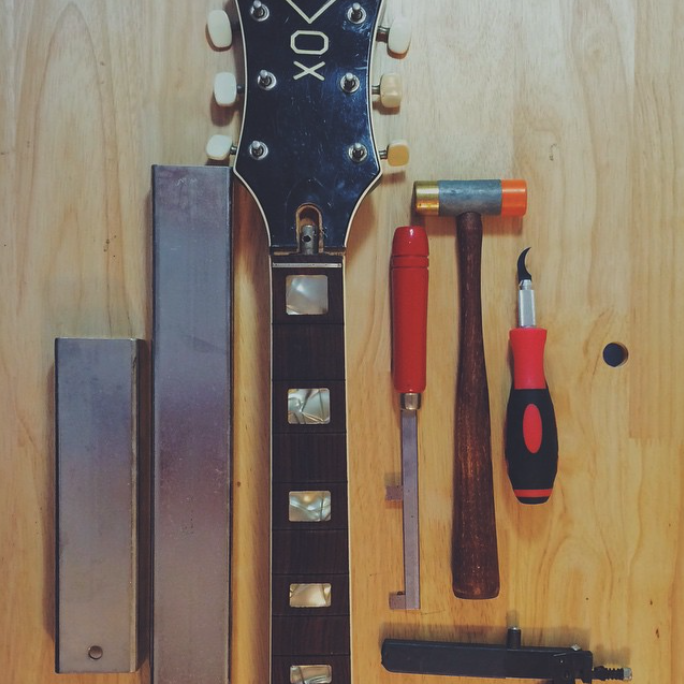
If your guitar is buzzing, rattling, or dying out during bends, the cause usually is not random.
In most cases, the problem comes down to one of a few things: neck relief, string action, nut slot height, a high fret, upper-fret geometry, or hardware that is vibrating where it should not be.
That is the frustrating part of guitar buzz. A small symptom can come from several different causes, and if you adjust the wrong thing first, you can make the guitar play worse instead of better.
We see this kind of issue all the time in repair work. Sometimes the fix is simple. Sometimes it is a setup problem that has been misdiagnosed for months. And sometimes what sounds like fret buzz is not fret buzz at all.
In this guide, I will walk you through how to diagnose guitar buzz step by step so you can tell whether you are dealing with a nut issue, a relief problem, action that is too low, a high fret, an upper-register clearance issue, or a repair that should go straight to a luthier.
This guide is written primarily for steel-string acoustic and electric guitars, but the same diagnostic logic often applies to other fretted instruments as well.
Quick Answer: What Usually Causes Guitar Buzz or Bend Choke-Out?
If you want the short version, here is where guitar buzz most often comes from:
Open-string buzz usually points to the nut.
Buzz on frets 1 through 5 often points to too little neck relief or backbow.
Buzz in the middle of the neck often points to a high fret, uneven fret wear, or setup that is close but not quite right.
Buzz high on the neck, especially during bends, often points to low action, uneven upper frets, or not enough fall-away in the upper register.
A rattling sound on an acoustic guitar may not be fret buzz at all. It could be loose hardware, a brace issue, bridge-related vibration, or a saddle contact problem.
The key is not to guess. The fastest way to find the real cause is to identify where it happens, when it happens, and then measure the guitar in the right order.
In This Guide
You will learn:
- how to narrow down buzz by location
- how to tell whether the issue is the nut, relief, action, or a fret problem
- which measurements to take first
- why notes choke out during bends
- which fixes are reasonable DIY adjustments
- when it is smarter to stop and bring the instrument in
Start Here: When and Where Is Your Guitar Buzzing?
Before you touch the truss rod or bridge, answer two questions:
Where on the neck does it happen?
And does it happen on open strings, fretted notes, or only during bends?
That alone can save you a lot of time.
Open-string buzz only
If a string buzzes when played open but sounds clean when fretted, the nut is the first place to look.
Most often, that means the nut slot is too low or shaped incorrectly. A badly shaped nut slot can also create a “sitar-like” buzz if the string is not breaking cleanly at the front edge of the nut.
Less often, the problem is farther back at the saddle or bridge, especially if something is vibrating in the afterlength or hardware.
Buzz on frets 1 to 5
Buzz in the lower positions often points to too little neck relief.
If the neck is too straight, or has a slight backbow, the string does not have enough room to vibrate cleanly in the first part of the neck. This is one of the most common causes of buzzing on the first few frets.
Sometimes low action makes it worse, but relief is usually the first thing to confirm.
Buzz in the middle of the neck
If the guitar buzzes more around frets 5 through 12, relief can still be part of the story, but this is also where localized fret problems tend to show up.
A single high fret, uneven fret wear, or flattened fret crowns can all create buzz in this part of the neck, even if the overall setup looks normal.
Buzz high on the neck
Buzz high on the neck, especially above the 12th fret, often points to upper-register clearance problems.
That could mean action is too low for the way you play. It could also mean the upper frets are not level, or the neck and fret plane are not falling away enough toward the body.
This becomes even more obvious when notes die during bends.
Notes choke out during bends
If a note sounds fine until you bend it and then suddenly dies, you are usually dealing with a clearance issue in the upper register.
As the string bends across the radius of the fingerboard, its path changes. If it runs into a higher fret farther up the neck, the note chokes out.
That usually means one of four things:
The action is too low for your bending style.
The upper frets are uneven.
There is a hump near the body joint.
Or the guitar needs more fall-away in the upper register.
Before You Diagnose Anything Else, Separate Fret Buzz From Rattle
Not every buzz is fret buzz.
If you are working on an electric guitar, play the problem note unplugged and then through an amp. Sometimes a small amount of acoustic fret noise is not meaningful in the amplified signal. Other times, the noise is mechanical and has nothing to do with fret clearance.
If you are working on an acoustic guitar, listen for a rattle that does not track clearly to a fret position. A loose brace, bridge hardware, saddle contact issue, or other structural vibration can sound like fret buzz at first.
A simple tap test around the bridge and top can sometimes reveal a papery rattle that points to a loose brace. On some instruments, loose bridge hardware or nuts can cause a strange buzz that seems to come and go.
That is why the first job is not “fixing buzz.” The first job is identifying what kind of buzz you are hearing.
How to Tell if Your Guitar Buzz Is Coming From the Nut, Relief, Action, or a High Fret
Once you know where the symptom shows up, here is the simplest way to narrow it down.
If the buzz is on open strings only, suspect the nut.
If the buzz is mostly on frets 1 through 5, suspect relief first.
If the buzz is spread across the neck after a setup change, check relief and action together.
If the buzz is isolated to one note or one small area, suspect a high fret or a fret that is not fully seated.
If the buzz happens mostly above the 12th fret or during bends, suspect upper-fret geometry, uneven frets, or action that is too low for your playing style.
That sequence matters because many people start with the nut when the real problem is relief, or they raise the action when the real problem is a single fret.
What You Need Before You Start
You do not need a full repair bench to diagnose most buzz issues, but a few tools make the process much more reliable:
A capo
A set of feeler gauges
A string action gauge or precise ruler
A good tuner
A short straightedge or fret rocker
A proper truss rod tool for your instrument
Without measurement tools, most setup work turns into guesswork.
The 3 Measurements to Take in Order
This is the heart of the process.
Do not start by filing the nut.
Do not start by leveling frets.
And do not assume the action is the problem because the strings feel low.
Take these three measurements in this order.
1. Measure neck relief
Tune the guitar to the pitch you actually play in.
Capo the first fret. Then fret the low string at the last fret, or where the neck meets the body depending on your method. Measure the gap around the 8th fret with a feeler gauge.
If there is very little gap, or no gap, the neck may be too straight or back-bowed. That is a common cause of low-fret buzz.
If there is too much gap, the neck may have excess relief. That usually causes other playability problems, but the important point here is that you need to know the real geometry before adjusting anything else.
2. Measure string action
Once relief is known, measure the string height at the reference fret you use for your setup style.
Many players and techs reference action around the 12th fret. Some manufacturer specs use the 14th or 17th depending on the instrument. The important thing is consistency.
If the action is extremely low, that may explain widespread buzzing or upper-register choke-out. But do not use action alone to explain low-fret buzz until you have already checked relief.
3. Measure nut slot height
Do this last.
That order matters because cutting the nut before the neck geometry is sorted can create a much bigger problem.
If the buzz happens only on open strings, the nut becomes a prime suspect. You can do a quick practical check by fretting at the 3rd fret and watching the clearance over the 1st. If there is no movement at all, the slot may be too low. If there is a lot of movement, it may be too high.
High nut slots can also make first-position chords feel stiff and pull sharp. Low nut slots can cause open-string buzz.
How to Check for a High Fret or Uneven Frets
If relief, action, and nut height are all in a reasonable range but the buzz is still there, start checking for localized fret issues.
A fret rocker is one of the best tools for this.
Lay it across three frets at a time and see if it rocks. If it does, one of those frets is high.
That does not always mean the fret needs to be filed right away. Sometimes the fret is slightly lifted and needs to be reseated first. Other times the fret tops are just uneven enough that a spot level and re-crown is the real fix.
This is especially important when the buzz is:
localized to one note or one small section
showing up across multiple strings at the same fret area
or happening mainly in the upper register where bends die
Why Notes Choke Out During Bends on Upper Frets
Bend choke-out is one of the clearest signs that the upper register needs more clearance.
When you bend a string, you are not just raising pitch. You are moving the string laterally across a curved fretboard. That changes its path and can send it into a higher fret farther up the neck.
That is why a guitar can feel fine for normal playing but still die on big bends.
If bends are choking out, test the exact area where it happens.
Is it around frets 12 to 15?
15 to 17?
Only on the B and high E?
Only during whole-step bends?
That kind of detail matters.
If the guitar already has low action and minimal relief, the next places to look are upper-fret level, a possible tongue hump near the body joint, or insufficient fall-away. In many cases, slightly raising the action improves the symptom. In more stubborn cases, the real answer is fretwork, not another setup tweak.
Acoustic Guitar Buzzes That Are Not Fret Buzz
Acoustic guitars deserve their own category here because body-related noise gets misdiagnosed all the time.
Loose braces
A loose brace can create a papery, inconsistent rattle that seems to move around the guitar. It may appear only at certain notes or volumes.
Bridge or hardware rattles
On some guitars, bridge-related hardware can loosen and create a strange buzz that is easy to mistake for fret noise.
Saddle contact and break-angle problems
If the string is not breaking cleanly over the saddle, or the contact point is poor, you can get a buzz that sounds almost like a sitar effect.
These issues are different from fret buzz because the neck measurements may all be fine while the sound is still wrong.
Guitar Buzz Symptom-to-Cause Chart
Here is the fast-reference version:
Open strings buzz, fretted notes sound clean
Most likely cause: nut slot too low or nut slot shape issue
Buzz mainly on frets 1 through 5
Most likely cause: too little neck relief, sometimes combined with low action
Buzz mainly in the middle of the neck
Most likely cause: uneven fret, worn fret, or setup that is close but not quite right
Buzz localized to one note or one fret area
Most likely cause: high fret or a fret that is not fully seated
Buzz high on the neck or during bends
Most likely cause: low action, upper-fret unevenness, tongue hump, or lack of fall-away
Acoustic guitar makes a rattling or papery buzz
Most likely cause: loose brace, hardware vibration, bridge issue, or saddle contact problem
First-position chords feel stiff and go sharp
Most likely cause: nut slots too high
Which Buzz Fixes Are Safe to Try Yourself?
Some adjustments are reasonable DIY work if you are careful and have the right tools.
A small truss rod adjustment after measuring relief is usually a fair DIY task.
A small bridge saddle adjustment on an electric is also commonly manageable.
A modest action increase to see whether bend choke-out improves is usually low risk.
But other repairs move into advanced territory quickly.
Nut filing is easy to mess up and hard to undo cleanly.
Spot-leveling frets, re-crowning, and upper-register fretwork require real control and the right tools.
Loose brace repairs, bridge re-glues, neck resets, and structural acoustic work are not setup tasks. They are repair tasks.
A good rule is this: if the fix removes material permanently, or if a mistake could create a more expensive repair, slow down.
When to Take a Buzzing Guitar to a Luthier
There is a point where diagnosis is still useful, but DIY repair is no longer the smart move.
Bring the guitar in sooner rather than later if:
the truss rod does not turn smoothly
the neck appears twisted
relief does not respond normally to adjustment
the guitar keeps choking out on bends after a normal setup
you suspect a tongue hump or upper-register geometry issue
the acoustic guitar shows humidity-related movement
you hear a brace or structural rattle
the saddle is already low but the action is still wrong
or the nut and fretwork clearly need more than a light adjustment
In those cases, a professional diagnosis usually saves time and prevents chasing the wrong fix.
Frequently Asked Questions About Guitar Buzz
Why is my guitar buzzing only on open strings?
Most of the time, that points to the nut. If the buzz disappears when the string is fretted, the nut slot is one of the first things to check.
Why does my guitar buzz on the first few frets?
That usually means the neck does not have enough relief. A very straight neck or slight backbow can create low-fret buzz even if the rest of the setup looks close.
Can low action cause notes to choke out during bends?
Yes. Low action can reduce upper-register clearance enough that bent notes run into higher frets and die.
How do I know if a high fret is causing the problem?
If the buzz is localized to one note or one small area, and the rest of the guitar plays reasonably well, a high fret becomes much more likely. A fret rocker helps confirm it.
Should I file the nut first if my guitar buzzes?
Usually no. Relief and action should be checked first. If the guitar geometry is wrong and you cut the nut too soon, you may create a second problem.
Is some fret buzz normal?
Sometimes, yes. Especially on electric guitars, a small amount of acoustic fret noise may not matter in the amplified signal. The real question is whether it affects musical performance, sustain, feel, or intonation.
If Your Guitar Is Buzzing or Choking Out
If your guitar buzz is coming from a simple setup drift, a careful measurement-based adjustment may be all it needs. Choke outs are a guitar geometry issue 95% of the time.
But if the problem points to a low nut slot, high fret, upper-register choke-out, loose brace, or neck-angle issue, the right repair depends on diagnosing the cause correctly first.
That is where many players lose time. They start adjusting things in the wrong order, or they fix the symptom temporarily while the real problem stays in place. There is an order of operations on must follow otherwise you are chasing the dragon.
If your guitar is buzzing, rattling, or choking out on bends and you want a clear answer, bring it in for an evaluation. We can tell you whether the instrument needs a setup, fretwork, nut work, saddle work, or structural repair so you can stop guessing and get it playing the way it should.